What are the Benefits of Factory Bonding?
By Scott Phelps
Factory bonding is an outstanding option for complex and critical applications.
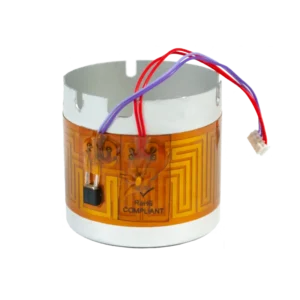
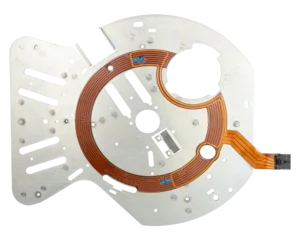
Birk Manufacturing offers a factory-bonding option, including laminating and vulcanizing, to help ensure intimate and uniform contact for reliable heater performance in critical applications.
Pressure-sensitive adhesive (PSA) is a great way to attach a flexible heater to a surface for many applications. However, other applications, especially those with complex geometries, curved surfaces, integrated components, and those that push the operating temperature limits of the heater could benefit from this factory installation.
Bonding alternatives to PSA
In this blog, we’ll discuss our recommended factory-installed bonding alternatives to PSA. Let’s go over a few definitions:
Pressure Sensitive Adhesive – Pressure sensitive adhesive allows for quick and economical installation. This is typically performed by the customer at their facility. The heater is delivered with a protected adhesive backing. Once removed, the heater can be attached directly to the surface.
Laminating/Lamination – A factory-installed bonding process for our Kapton/Polyimide FEP, Acrylic, HT and AP heater product lines. It uses an adhesive layer within the Kapton material, activated with heat, time, and pressure, to bond to the surface of the component, equipment, application or device.
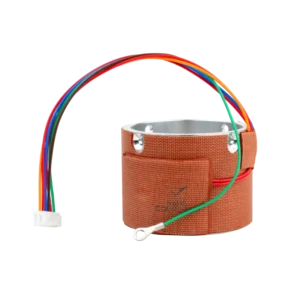
Vulcanizing/Vulcanization – A factory-installed process to bond silicone and butyl heaters to a component’s surface. It uses an uncured layer of rubber within the silicone or butyl to bond the heater to the surface through the application of heat, time and pressure.
Why choose factory installation instead of PSA?
There are several key benefits to choose laminating or vulcanizing over PSA:
- Strengthens adherence: Factory bonding (laminating or vulcanizing) can provide stronger adhesion with
 complex geometries, especially curved or cylindrical surfaces. Consistent adhesion using a PSA installation can be quite difficult in these complex situations.
- Improves uniformity: Factory bonding reduces the risk of air bubbles which can lead to inconsistent adhesion between the heater and the surface. These air gaps can interfere with heat transfer between the heater and the mounting surface. In some applications, this can contribute to uneven heating or can create hot spots. This is a particular challenge for curved or cylindrical surfaces, where maintaining uniform contact can be more difficult.
- Reduces damage: Flexible heaters often incorporate sensors, wire harnesses or other components. It is possible to damage those parts or connections during PSA installation. When factory-bonding, Birk’s technicians can bond the heater first, then safely attach additional components after the fact to reduce the risk of damage.
- Increases watt density capability: Vulcanization or laminating typically allows a heater to operate safely at a substantially higher watt density than a PSA installation.
 complex geometries, especially curved or cylindrical surfaces. Consistent adhesion using a PSA installation can be quite difficult in these complex situations.
Case study
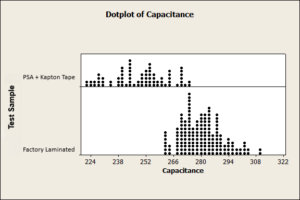
One of our current customers tested heaters factory-bonded by Birk against identical heaters they had attached in-house using PSA to the same component. The results of their testing highlighted a superior bond between our factory installed heaters compared to the customer installed PSA ones.
From the end-customer:
- The capacitance of Birk laminated prototypes was measured consistently around 260 – 300 picofarads (pF), a very desirable result and marked improvement from the PSA version measuring 220 – 260 pF.
- Birk factory laminated the heater foils directly to a copper sleeve using the same thermal adhesive that is used in the Kapton laminate of the heater. No extra adhesive was needed.
- The leads for all components were spot-welded after the heater foil was in place, eliminating the customers concern that the components could loosen during heater application and eliminating the need for the customer to build an application fixture.
PSA is still a great solution for many applications, but when things get more complicated – whether it’s the geometry, curved surfaces, concerns about integrated components or the performance of the heater in a critical application – having Birk handle the installation can be a valuable option.